
 The Inheritance – Part 1:
The Inheritance Part 1 introduces audiences to the well-trodden tales of the lives of a certain kind of New York gay man. Tales that are, for the most part, important and somewhat relevant, this work all too often ends up being little more than a beige mix of stories that are as hollow as they are long.
Matthew López breathes life into the world of leading characters Eric Glass and Toby Darling, two utterly endearing and infuriating characters whose lives are filled with love, loss, and a loud brash exciting ensemble of friends, acquaintances, and strangers. Over the course of Part 1, audiences bear witness to the many ways in which small moments have great effect on these two lives and to those around them.
López cunningly uses a combination of narrative and dialogic devices to bring the story to the stage, seamlessly shifting between the two to hold an audience’s attention and bring to the surface much needed explosion and insight into the minutiae of the character’s world.
The dialogue feels familial and grounded, there is a comfort to the way these characters are able to unfold their lives, however there are too many times where moments descend into a Mamet like lecture, a Tedtalk on the socio-political struggles of the characters and their world, lectures that leave the audiences to wonder “do people really talk like this?”
Much of the production’s issues stem from Shane Anthony’s uninspiring direction. From the first line the actor’s deliver an awkward heightened performance, void of any emotional grounding or character intent. Instead, the stage is left with half formed characters moving aimlessly as the pace lags and the narrative falls into cliché.
 The emotional arc of the work feels manipulated rather than sincerely earned, relying on the audience’s lived experience or knowledge to connect with the subject matter rather than allowing genuine connection to form outwardly from the cast.
John Adam, Simon Burke, Teale Howie, Ryan Panizza, Tom Rodgers, Zoran Jevtic, Quinton Rofail Rich, Matthew McDonald, Elijah Williams, Jack Mitsch, Bayley Prendergast, and Jack Richardson work well as an ensemble, but with many carrying the torch as others struggle to find their way through the work.
Ryan Panizza and Simon Burke manage to create compelling complexities from the little direction given, with both running the gamut of their character’s warts and all journeys. Teale Howie and Tom Rodgers round out the main cast and unfortunately do not bring more than very surface level performances to the stage.
Both rely on melodrama to connect with the work, keeping their scene partners at arm’s length and wistfully staring into space to conjure a tension that just never comes.
Kate Beere’s set is utterly flawless, a simple and raw space for the stories to bloom with colour – colour that sadly never came. Likewise, Alex Berlage’s lighting perfectly complements and creates rooms, hallways, parties, and parlours in the blink of an eye.
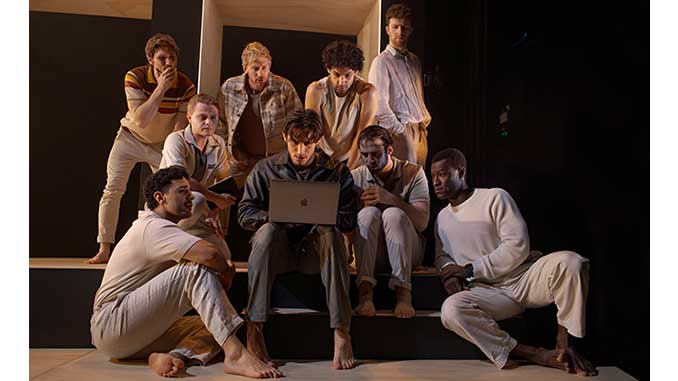
Tim Chappel shrouds the performers in varying shades of beige, a design choice that becomes less about telling a story and more about signifying the performances and production the audience is to witness. Jessica Pizzinga’s sound design is at times underutilised as when it is used to heighten moments and enhance the tension, audiences are gifted with the designs’ haunting beauty.
So much of this production should work as the script has been met with rave reviews the world over and for the most part, an audience can see the effort made, but it is just not enough to simply rest on the laurels of epic theatre and expect the highly impactful subject to get the production over the line.
 The Inheritance – Part 2:
The Inheritance -Part 2 instantly builds upon the groundwork of its first offering, giving the story much needed momentum to drive the narrative to a close. Despite being an incredibly professional and aesthetic performance, Lopez’s many themes within the script are never explored beyond the surface and instead this production rests on emotional manipulation as well as audiences’ lived experience to provide any discerning impact.
Kate Beere’s minimalist set, complimented beautifully by Alex Berlage’s lighting design, continues to be the most noteworthy contribution to this production. It’s simplicity, vastness and beauty allow for the plot and its characters to transition with ease into a multitude of locations.
It worked in Part 1 and continues to work here with Shane Anthony’s adequate direction utilising the gorgeous space his team have created. These transitions are of course aided by Jessica Pizzinga’s fantastic sound design which always brought clarity to the time and place in which the scenes took place.
This cannot be said for Tim Chappel’s costume design. It’s understandable why they went in the direction of simple beige coloured chinos and linen tops to bring cohesion to the ensemble, but these are gays in New York City. This design completely ignores the cultural zeitgeist in which these characters inhabit.
The consequence is that all the characters become homogenised, with resemblance closer to a heterosexual group of men from the east of Sydney. A real shame for a play that should celebrate the uniqueness and individuality that is ever-present in the LGBTQIA+ community.
Performances across the entire ensemble of actors remain solid with some succeeding more than others in their commitment to character. Regardless, the ensemble work was gorgeous to watch.
Everyone contributes to the weight of the storytelling through their heightened focus and support towards leading characters, embodiment and shifts into multiple minor roles, as well as their physicality and connection as a chorus.
Elijah Williams and Bayley Prendergast were standouts throughout. Both were able to sit within the material given to them, actualising the significance of the play’s messages without presenting caricatures.
 Amongst the leading characters Ryan Panizza’s Toby Darling, Simon Burke’s Walter Poole/E. M Foster and Vanessa Downing’s Margaret were all magnificent.
Panizza’s performance as Toby continues to hit all the right chords in portraying this narcissistic and self-destructive writer, who although is insufferable, audiences can’t help but have sympathy for as you watch his life completely fall apart. However, Panizza is done a dis-service as the material doesn’t give his Tobey Darling a complete arc rather boxing him into a timeless troupe of broken people break others.
Margaret is a mother who has lost her son to AIDS many years ago but continued to take care of patients who inhabited the house. She only appears in the final act to offer guidance and knowledge to Leo and Eric.
Regardless, Downing makes the most of her little time on stage, presenting a real woman who has come to terms with the injustices of the past through expert storytelling and a grounded heartfelt performance. Furthermore, Simon Burke, although not as involved in this part delivers another sophisticated and masterclass performance.
Moreover, John Adams’ grounded presentation of Henry Wilcox steals the show. This affluent businessman is not only grieving the loss of his partner Walter Poole, but his many friends taken by AIDS. This character keeps those he loves at a distance to protect himself, yet his vulnerability is ever present because of Adam’s nuance, presence and comfortability on the stage.
A highlight of the entire production was in the first act of Part 2 when Eric Glass (Teale Howie) introduces all his democratic friends to Henry Wilcox, who they soon realise is an avid republican. The scene divulges into a variety of socio-economic and political discourse, some of the finest writing of the show, culminating in Wilcox screaming – “There are no gay men my age! Not nearly enough.”
This moment was superb and pierced into audience’s hearts due to the weight of the dialogue being actualised by Adams’ connection to the material. This level of performance sadly cannot be said for all the leading actors.
 Tom Rodgers sat sufficiently in the role of Adam in the first part and continues to in the second. However, it is his lack of any real discernible shifts in physicality and performance when portraying the 19-year-old, drug addicted sex worker, Leo, which proved underwhelming.
This wasn’t aided by the lacklustre direction of sequences in which his character is gang-banged at a meth in-fuelled orgy on Fire Island or when his Leo and Panizza’s Toby are finally reunited, and an emotionally underwhelming fight ensues. The production never really meets the intensity of its subject matter. Once again, this production seems to privilege aesthetics over genuine, deliberated performances.
Perhaps with more considered direction and further developed performances across the board, the script could have flourished. Albeit the most palpable problem is within the script itself. Throughout its collective six-hour runtime, the script aims to converse on a wide array of themes pertaining to the lived experiences of gays throughout history.
However, a lot of this never seems fully realised and rather tokenistic as if Lopez was ticking boxes to secure his Tony win. The text is littered with stereotypes of the gay community, which of course exist for a reason but in a work as long as this, one would hope dives deeper than it ever does.
I think after all the LGTQBIA+ community has been through we deserve a better script then what we are given. Where is the campness within this group of friends? Where’s the fashion? Why are all the characters built upon cliches? Why are they all so privileged? Where is the diversification in body types?
This script can easily be deemed as the Taylor Swift of theatre. Sure, it has its charm and aims to discuss issues within the LGBTQIA+ community, nevertheless becomes an overly commercialised, watered down, beige work that has four-quadrant appeal.
It’s lovely for this production company to have such success with this work as it’s never easy to develop independent theatre and they have achieved this to a very high standard. But one must question why has this text’s overwhelming problems been so egregiously ignored?
The Inheritance
Reginald Theatre – Seymour Centre, City Road and Cleveland Street, Chippendale (Sydney)
Season continues to 30 November 2024
Information and Bookings: www.seymourcentre.com
Images: Ryan Panizza (centre) and Cast in The Inheritance – photo by Phil Erbacher | Teale Howie (centre) and Cast in The Inheritance – photo by Phil ErbacherTom Rodgers, Ryan Panizza and Cast in The Inheritance – photo by Phil ErbacherTeale Howie, Tom Rodgers, Quinton Rofail Rich and Vanessa Downing in The Inheritance – photo by Phil Erbacher | Tom Rodgers and Simon Burke in The Inheritance – photo by Phil Erbacher
Review: The Inheritance – Part 1: Gavin Roach | The Inheritance – Part 2: Lee Andrews